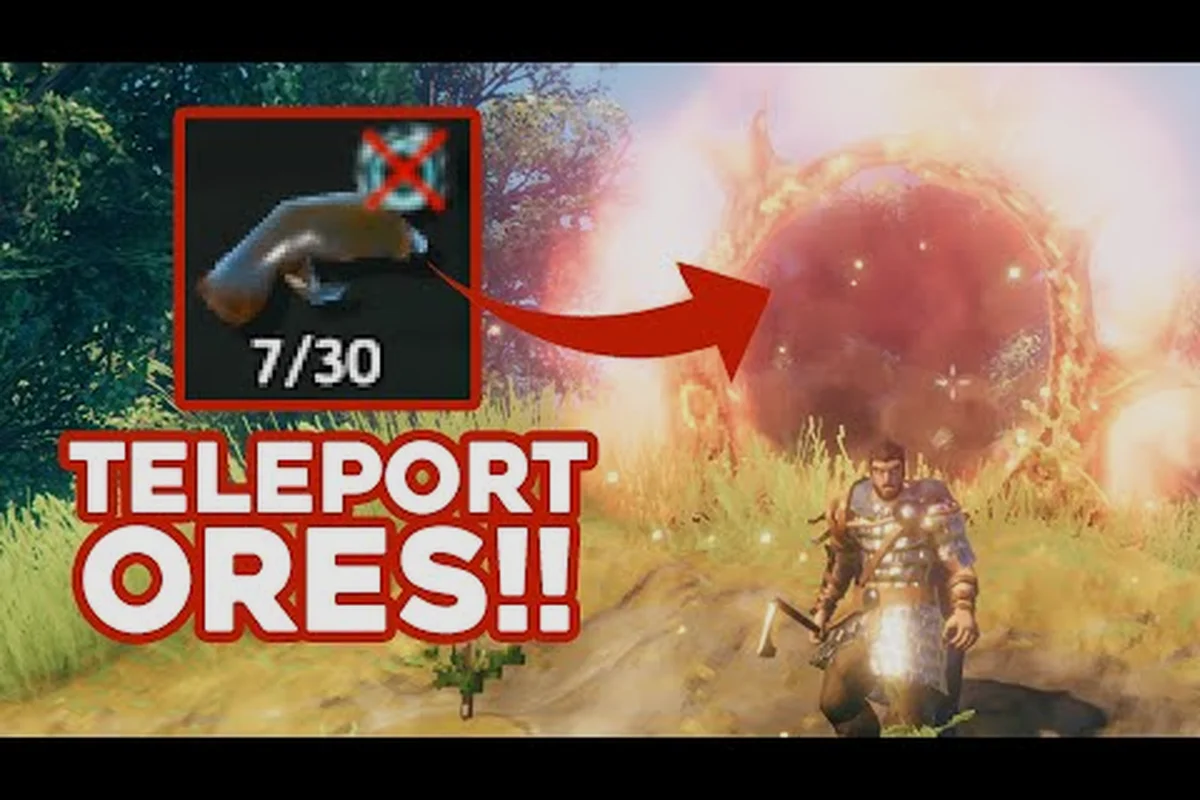
If you have ever loaded a stack of copper ore into a portal and watched it stay stubbornly in your inventory while the rest of your gear passed through, you have already met one of Valheim's defining survival rules. Valheim teleporting metals is the core mechanic every Viking must learn: raw ore, unsmelted ingots, and several other restricted materials physically cannot pass through a portal, so the only way to keep your base supplied is to smelt on-site, build strategically, and use boats. This guide breaks down exactly which items are blocked, which items you can carry through, and the most efficient routes using the Karve, Longship, and the late-game Drakkar.
Why Valheim Blocks Metals Through Portals
Valheim's portal restriction is not a bug or a hidden toggle — it is an intentional design choice that pushes players to engage with the world, sail its oceans, and use the Valheim on Steam sandbox loop. According to the official store page and confirmed by the Valheim Wiki – Fandom, portals are restricted so that smelting and shipping remain meaningful progression steps rather than optional conveniences.
What You Can and Cannot Teleport
The blocked-item list is the same in single-player and on dedicated servers, and it has not changed since portals were introduced in the Hearth & Home update. Here is a clean snapshot of the rules as of the 1.0 release:
| Material Type | Teleport Allowed? | Notes |
|---|---|---|
| Raw Copper Ore / Tin Ore | No | Smelt into bars at a Charcoal Kiln + Smelter outpost |
| Raw Iron / Silver / Black Metal scrap | No | Must be smelted before portal use |
| Smelted bars (copper, tin, bronze, iron, silver, black metal) | Yes | The cornerstone of any Valheim farming guide |
| Coal | No | Stack 100 at the smelter, not in the portal queue |
| Wood / Stone / Flint | Yes | Common building materials pass freely |
| Carrots / Turnips / Barley / Flax seeds | Yes | Crops and seeds are unrestricted |
| Trophy items (Boar, Deer, Greydwarf) | Yes | Trophies and trophies-mountable items pass |
| Coins, Amber, Ruby, Amber Pearl | Yes | Valuables are not portal-locked |
| Dragon Tears, Yagluth Thing, etc. | Yes | Boss drops pass through portals |
The Smelter Outpost Pattern
Since ore cannot pass through a Valheim portal, every raw metal ingot you bring home must first be smelted at the source — so the pattern experienced players converge on is to pair a Smelter and Charcoal Kiln with a nearby Portal, turning the mining site itself into a small forward outpost where you convert Tin ore, Copper ore, or Silver ore into bars before you ever consider loading a Karve for the voyage back. This on-site conversion is the only way to avoid a death run that drops your entire ore stack into the ocean biome, and it also means each teleported smelted bar is worth five times the carry weight of its raw form, dramatically stretching the value of every Longship trip and fueling your Plains progression.
-
Build a Portal within ~50 meters of the Smelter and Charcoal Kiln cluster.
-
Smelt your ore into bars at the outpost.
-
Drop the bars into a Cart or directly into a chest on the Karve / Longship / Drakkar for the voyage home.
The community consistently reports that placing the smelter right next to a Workbench and a small portal shack dramatically reduces the number of round trips, because the moment you smelt, you can teleport wood, stone, nails, and refined materials back to the main base for crafting. This Valheim farming guide approach to metal is what separates a struggling Viking from one who walks into the Plains biome fully geared.
Smelt, Smelt, Smelt: The Ore-to-Bar Pipeline
Smelting is the heart of Valheim teleporting metals strategy. Each metal requires a specific fuel ratio, and getting the numbers right saves you hours of charcoal farming. The 1.0 release did not change the smelting ratios, but the Drakkar (Deep North tier ship introduced in the full launch) makes bulk shipping dramatically easier.
Smelting Requirements by Tier
| Ore Type | Smelter Needed | Fuel Per Bar | Smelt Time | Notes |
|---|---|---|---|---|
| Copper | Smelter | 2 Coal | ~30 sec | Use a Kultite-tier pickaxe for best yield |
| Tin | Smelter | 2 Coal | ~30 sec | Found along riverbanks in Black Forest |
| Iron | Smelter | 2 Coal | ~30 sec | Requires Swamp Key to access Muddy Scrap Piles |
| Silver | Smelter (with Frost Caves scrap) | 2 Coal | ~30 sec | Detected with Wishbone after Moder |
| Black Metal | Blast Furnace | 4 Coal | ~40 sec | Plains biome only, unlocked after Yagluth |
| Flax / Barley | N/A (crops, not smelted) | — | — | See farming section below |
Why You Always Need Extra Charcoal
Charcoal is itself portal-blocked, so the moment you smelt, you must plan fuel logistics. The typical Viking pattern is to keep 100 coal in a chest next to the smelter, ferry in wood from the main base via portal, and burn it into coal at the Charcoal Kiln while the smelter is running. Players on the r/Valheim subreddit consistently report that running two kilns per smelter is the most efficient charcoal-to-bar ratio, and many solo players upgrade to a small windmill-powered charcoal farm once they hit the Plains tier.
Ships, Carts, and the Ocean Highway
When you need to move serious tonnage, the only real option is water transport — and the Karve versus Longship versus Raft decision directly determines how fast your metal pipeline runs. New players often default to the Raft because it costs only 20 Wood and 6 Leather Scraps, but it has no mast, no storage chest, and drifts at roughly half the speed of a Karve, making long hauls from a Blackmetal node back to your base painfully slow. The Karve (30 Fine Wood, 10 Deer Hide, 80 Bronze Nails, 20 Resin, 20 Leather Scraps) is the correct mid-game choice for solo metal runs thanks to its 4-slot inventory and forward speed comparable to a Longship.
Ship Comparison for Metal Hauling
| Ship | Cost | Cargo Slots | Speed | Best Use Case |
|---|---|---|---|---|
| Raft | 20 Wood, 6 Leather Scraps, 6 Resin, 10 Rope | 8 (no chest) | Very slow | Emergency trips only |
| Karve | 30 Fine Wood, 10 Deer Hides, 20 Resin, 80 Nails | 4 (with chest) | Medium | Solo early-game metal runs |
| Longship | 100 Iron Nails, 40 Fine Wood, 10 Deer Hides, 40 Wood | 18 (with chest) | Fast | Mid-game Black Forest / Swamp hauls |
| Drakkar | 200 Iron Nails, 100 Fine Wood, 30 Deer Hides, 40 Tar, 10 Chitin | 30 (with chest) | Fastest | Late-game bulk transport (1.0 release) |
The Drakkar is the standout late-game vessel for any Viking running Valheim teleporting metals logistics at scale, because it can carry a full smelter-output haul in one trip. According to community testing published shortly after the 1.0 launch, the Drakkar's 30 cargo slots make it the most efficient option for shipping silver bars from the Mountains and black metal bars out of Fuling villages in the Plains.
Carts as the Land Alternative
For shorter overland hauls — say, from a Swamp crypt to a lakeside dock — the Cart is often faster than a ship. The Cart has 8 cargo slots, can carry 300 kg, and works on roads. Players who build cultivated stone roads between their Swamp outpost and the nearest ocean inlet report far fewer broken carts and a much smoother Valheim teleporting metals pipeline overall.
Valheim Farming Guide: Crops That Pair with Metal Logistics
Crops and seeds are not portal-restricted, so you can teleport carrots, turnips, barley, and flax freely. That is a critical detail: while you cannot fast-travel your smelted setup, you can teleport the entire seed and crop side of your economy to keep your main base fed while you spend weeks smelting in the wild.
Seed-to-Crop Yields
| Crop | Where to Find Seeds | Plant In | Growth Time | Yield Per Seed |
|---|---|---|---|---|
| Carrot | Black Forest | Cultivated (Cultivator) | ~3 in-game days | 1 carrot |
| Turnip | Swamp chests | Cultivated | ~3 in-game days | 1 turnip |
| Barley | Plains (Fuling villages) | Cultivated | ~3 in-game days | 1 barley |
| Flax | Plains (Fuling villages) | Cultivated | ~3 in-game days | 1 flax + 1 linen thread at Spinning Wheel |
Valheim How to Farm Carrots
Carrots are the first crop a new Viking meets, and the answer to Valheim how to farm carrots is straightforward: harvest them from the wild Black Forest floor (they look like orange roots in the ground), then use a Cultivator with 5 Core Wood to plant more. Plant them in rows, leave one tile of space between seeds, and they regrow every three in-game days as long as they are in Cultivated soil. Carrots are critical for early boar taming and for crafting Carrot Soup, which is one of the best early-game stamina foods in the entire Valheim farming guide ecosystem.
Valheim How to Farm Turnips
The short answer to Valheim how to farm turnips is: loot them from Swamp biome chests, especially inside Sunken Crypts and around Draugr villages. Once you have a stack, plant them in cultivated soil the same way you plant carrots. Turnips are used to craft Turnip Stew, the stamina-and-health staple that carries most Vikings through the Bronze and Iron Age. Because turnips can be teleported, you can stockpile them at your main base and run crop logistics independently of your metal logistics.
Valheim Barley Farming
For Valheim barley farming, you need to push into the Plains biome, which is unlocked after defeating Bonemass. Barley seeds drop from Fuling camps, and you plant them in cultivated soil the same way you handle carrots and turnips. Barley is the ingredient behind Bread and Loasted Crust Pie, which are top-tier stamina foods in the late game. Because seeds and crops pass through portals, you can farm barley in the Plains and teleport it back to your main kitchen instantly.
Valheim Flax Farming
Valheim flax farming mirrors barley almost exactly, with the key difference that flax must be processed at a Spinning Wheel into Linen Thread before you can craft it into Linen and eventually Padded Armor. Flax grows in the Plains on cultivated soil and takes about three in-game days to mature. Because flax is portal-friendly, you can plant a large field right next to a Plains portal and teleport the raw crop back to a Spinning Wheel at your main base for efficient processing. For more on the broader progression chain that comes after you have your crops and metals sorted, the Valheim boss order guide maps out the next gate to chase.
Late-Game Teleport Tricks and Common Mistakes
Once you understand the rules, you can compress the entire Valheim teleporting metals pipeline into a smooth routine. The key is to treat portals and ships as two halves of the same logistics chain rather than as alternatives to one another.
Building a Self-Sufficient Smelter Outpost
A typical late-game smelter outpost looks like this: a compact cluster anchored near a Black Forest or Plains biome boundary, positioned roughly 200–300 meters from the nearest Portals so smelted copper, tin, bronze, iron, silver, or black metal bars can be ferried back in one or two hauls rather than dozens. Because metals weigh 3x more than wood and ore, every trip through a portal that is skipped translates to saved carry weight and a faster Karve or Longship turnaround. Placing the smelters downhill from the kilns also lets you use the terrain's natural slope to roll a Cart between stations without burning stamina on flat ground.
-
Portal shack with a workbench and a chest for fuel and finished bars.
-
2–4 Charcoal Kilns for steady coal production.
-
2 Smelters (or Blast Furnaces for black metal).
-
A small shelter with a bed and a fire so the area becomes a respawn point.
-
A dock with a Longship or Drakkar moored and ready for the haul home.
This layout lets you smelt, refuel, and ship without ever backtracking on foot, and it is the standard pattern the Valheim community has converged on for the Valheim resources tier of play. Portaling only the finished bars back to your main base — while leaving raw copper, tin, iron scrap, and silver ore stockpiled at the smelter outpost — sidesteps the per-stack weight penalty that makes solo Karve runs across the Black Forest or Mountains feel like a chore, and keeps your Longship holds reserved for black metal scrap hauls from a Plains-side dock that would otherwise eat 20+ minutes of round-trip sailing per batch.
Common Mistakes to Avoid
Even experienced Vikings slip on a few of these: the most common offenders come from treating portaling as an automatic substitute for proper logistics — like depositing a full stack of copper or silver bars straight from a swamp crypt or Frost Cave without first emptying your hotbar, which can silently despawn the ore if your portal disconnects mid-transfer. Another subtle mistake is relying on a portal while a Troll or Greydwarf Shaman is still agro'd on you, since the ore transfer can fail the moment the server despawns your character on the wrong side.
-
Smelting without enough coal in the chest — the moment your kilns run dry, your whole chain stalls. Keep at least 100 coal next to the smelter at all times.
-
Forgetting to drop the bars off the ship — Longship and Drakkar cargo survives if the ship is destroyed on a rock, but the haul is lost. Always pull into a calm cove before unloading.
-
Planting crops in non-cultivated soil — only Cultivator-tilled ground will grow carrots, turnips, barley, or flax. Standard ground will not.
-
Forgetting the Wishbone — without a Wishbone (from Bonemass), you cannot detect buried silver veins, which severely limits your late-game smelt output.
When to Use a Portal vs. a Ship
Use a portal for: any smelted bar, wood, stone, food, seeds, coins, refined ingots, and all weapons or armor you craft at the outpost. Portal-friendly items weigh nothing in the queue once a portal tag is placed at both ends, so smelted copper, tin, bronze, iron, silver, and black metal bars can be moved to your main base in seconds instead of ferrying them across the Ocean biome in a karve or longship, leaving the cargo hold free for ore that the portal refuses to accept.
Use a ship for: raw ore (before smelting into bars), coal, chitin (harvested from deathsquitos and_goblin_shamans in the Plains for Drakkar crafting), and bulk tonnage you would rather not push through the portal queue one stack at a time. A single longship holds 18 cargo slots, so a fully loaded Karve (4 slots) cannot carry a full Black Metal scrap run; plan two round trips or upgrade to the longship before sailing the Ocean biome with unmovable cargo.
The standard workflow for Valheim teleporting metals is: smelt on-site, ship the bars home if the haul is large, and use the portal for everything else. Mixing the two modes keeps the chain efficient and lets you progress into the Valheim building guide tier of play without ever grinding bars at your main base.
Frequently Asked Questions
Can you teleport copper ore in Valheim?
No. Raw copper ore, tin ore, iron scrap, silver ore, and black metal scrap are all portal-blocked. The only way to move them is by ship or cart, and the only way to fast-travel them is to smelt them into bars first. According to community data, this rule has not changed since portals launched.
Why can't you teleport ore but you can teleport bars?
It is an intentional survival-game design choice to keep the smelting and shipping loops meaningful. Bars represent the smelted, refined output of your work, so the game lets you fast-travel them, while raw ore forces you to engage with the world, smelt at the source, and use the Karve, Longship, or Drakkar for transport.
How many bars fit in a Longship vs. a Drakkar?
A Longship chest holds 18 slots, while a Drakkar chest holds 30 slots. Because smelted bars stack to 30 per slot, a fully loaded Drakkar can carry 900 bars in a single trip, which is the most efficient bulk option for late-game shipping.
Can you teleport crops and seeds in Valheim?
Yes. Carrots, turnips, barley, and flax — including their seeds — are all portal-friendly. This is why a typical Valheim farming guide recommends planting a field of barley and flax right next to a Plains portal and teleporting the harvest straight back to your main base for processing at the Spinning Wheel.
What is the fastest ship in Valheim for transporting metals?
The Drakkar is the fastest and largest cargo ship in the 1.0 release, and it is the best late-game option for hauling smelted bars. The Longship remains the best mid-game option, while the Karve is ideal for early-game solo Viking runs between the Black Forest and your main base.